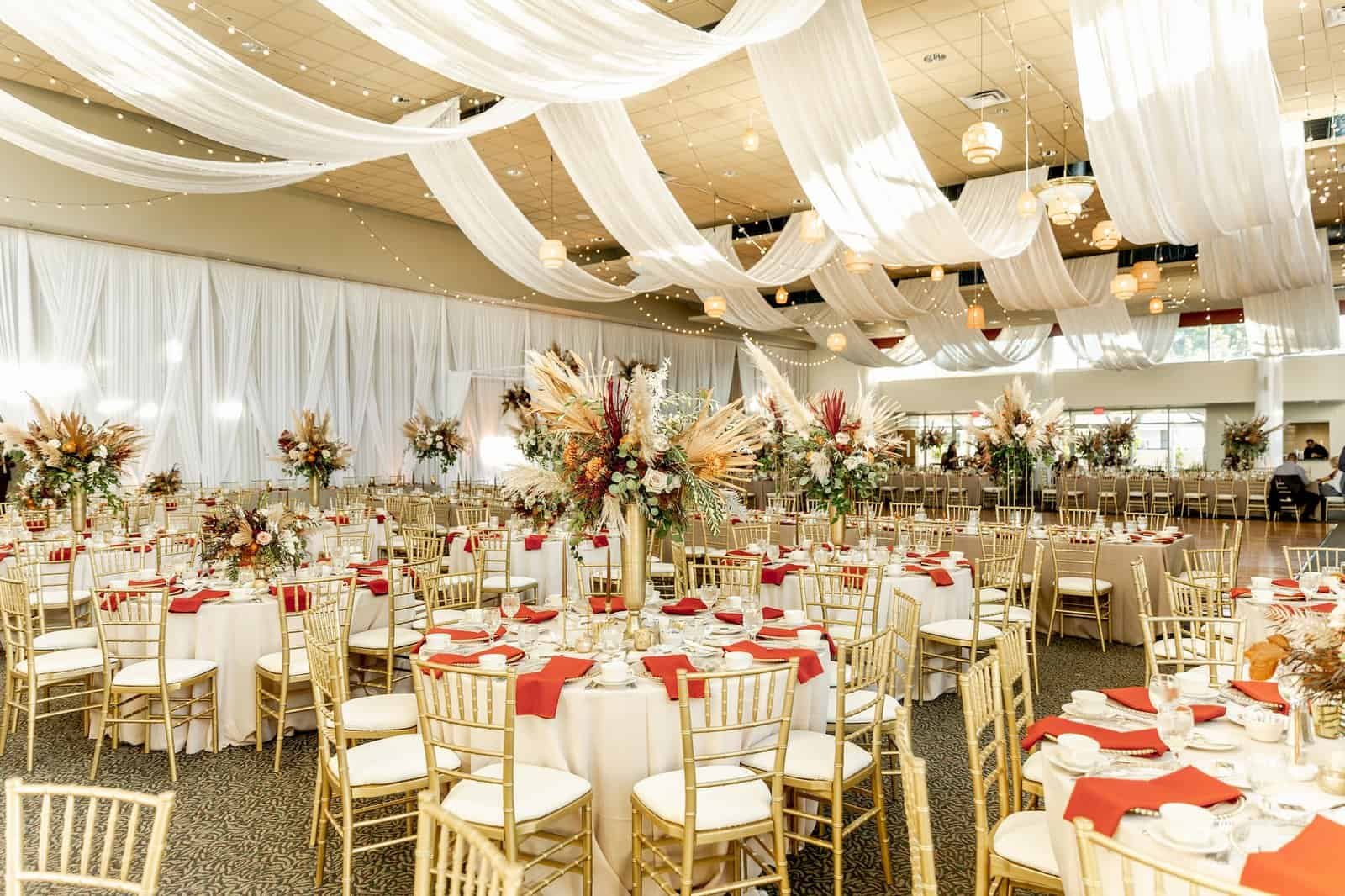
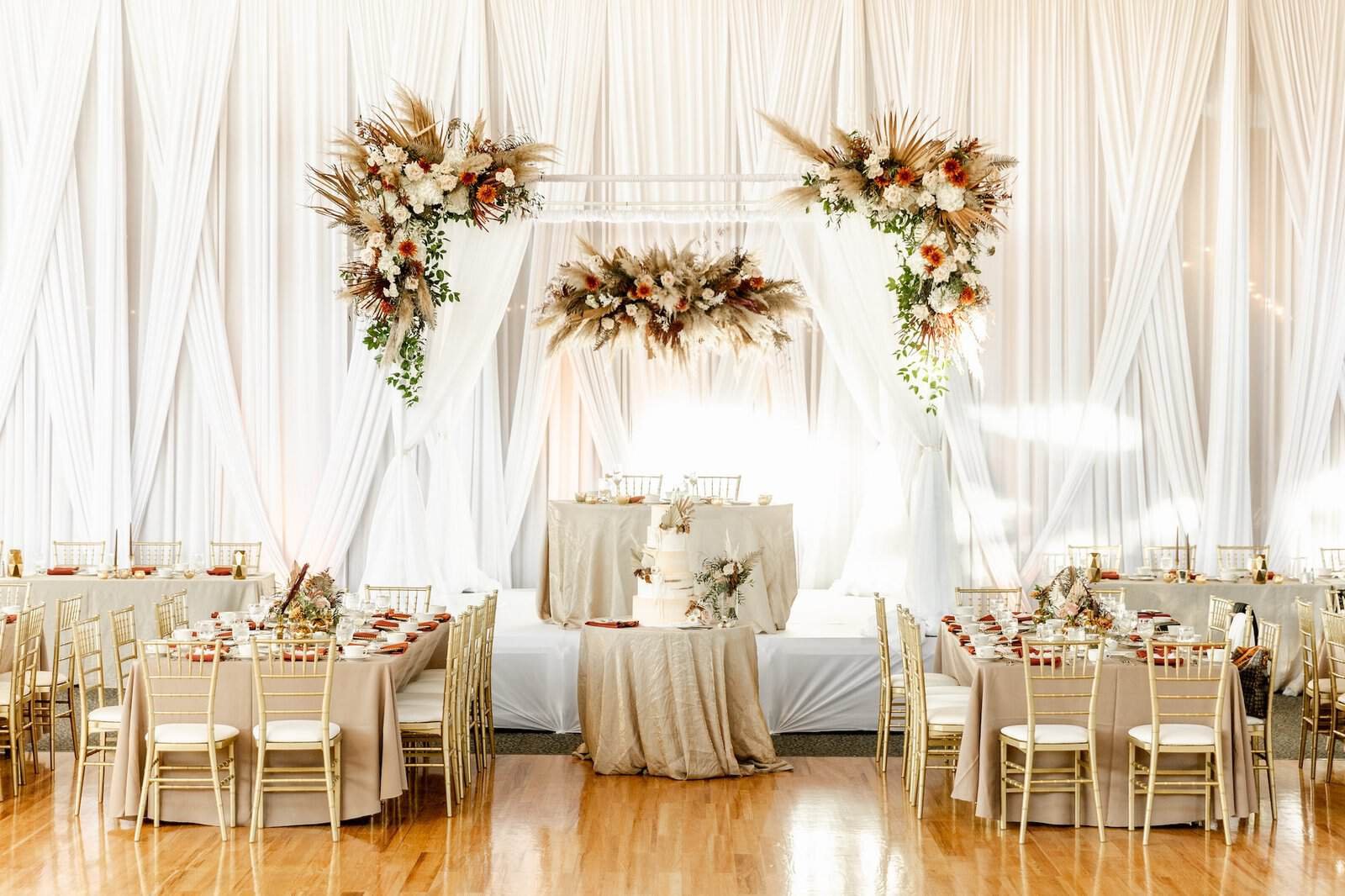
A community hall is the most honest venue there is. It gives you a big, clear, flat space, a serviceable kitchen, parking, and absolutely nothing else. The ceiling is the giveaway — a grid of tiles, fluorescent troffers, sprinkler heads and air diffusers, sitting about three metres above a room you are trying to make look like a fall wedding in Greece.
That is why this order was weighted the way it was. Gabro supplied the ceiling drape, the wall draping, the lighting, the Chiavari seating and the tables. The linens and the flowers came from elsewhere. In a hall like this the ceiling is the largest single surface a guest sees all night, and it is the one almost nobody budgets for.
Draping the ceiling, not just the walls
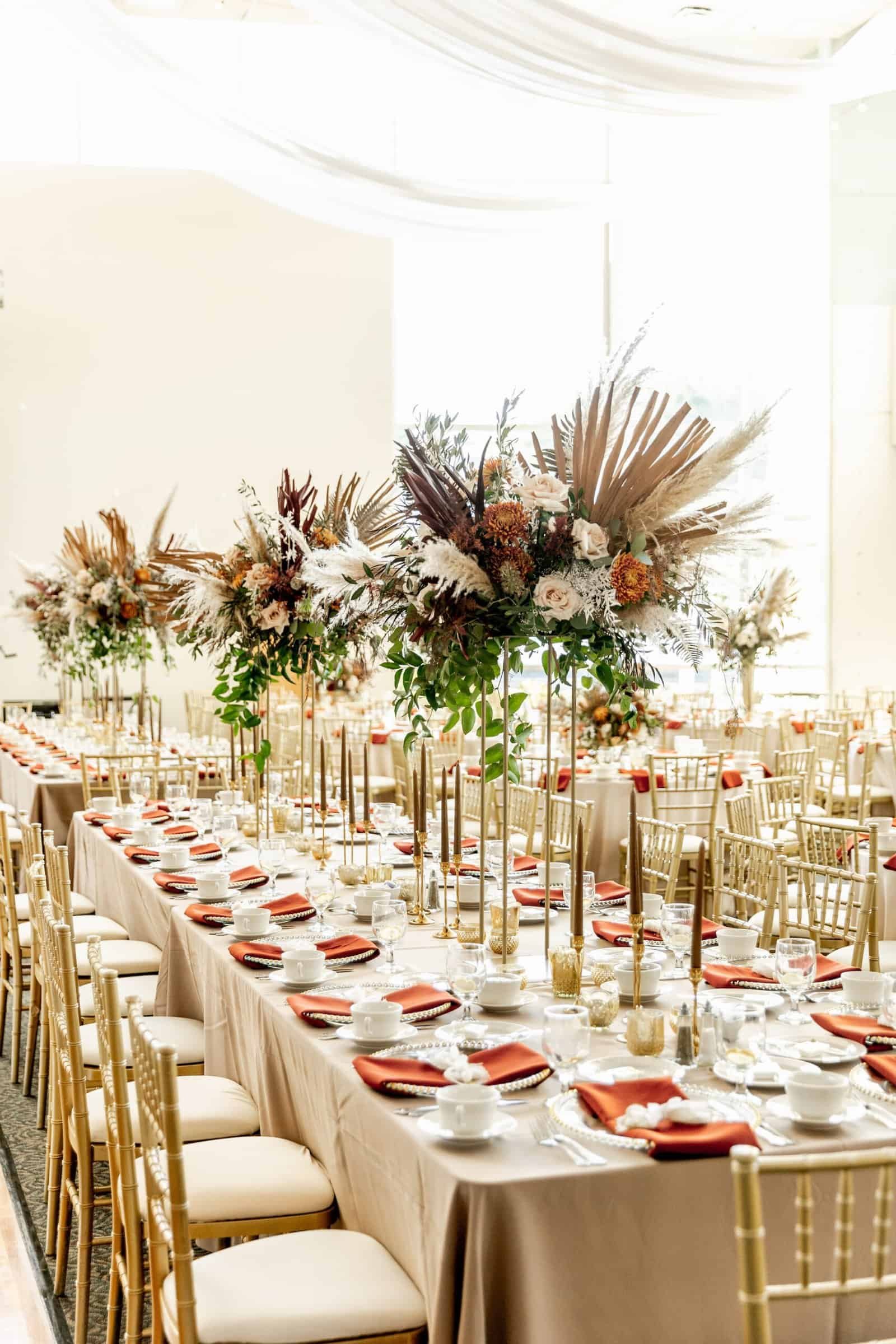
White fabric was swagged from a centre point and run out across the room, so the ceiling reads as a soft radial canopy rather than as a grid. This is the change that photographs in every wide frame, and it is the one people are most surprised by, because from inside the room you stop noticing the ceiling almost immediately — which is exactly the point.
A tiled or troffered ceiling does two bad things at once. It puts a hard, repeating pattern above every photograph, and its fluorescent fixtures throw a flat, greenish light straight down onto the tops of heads. Fabric solves both: it hides the grid, and it turns any light you put near it into a soft, indirect source instead of a hard one.
Rigging is where the skill is, and it is not decorative work. Every attachment point has to be a point the building can actually carry — structural steel, purpose-fitted anchors or a ground-supported frame, never a ceiling tile, a light fixture or a sprinkler pipe. Sprinkler heads must stay clear and unobstructed, and fabric has to be flame-retardant rated for the room. The swag is then tensioned evenly, because an uneven drop is far more visible from below than it ever looks from a ladder.
Shop this look
Lighting the fabric rather than the room
With fabric overhead, the lighting had somewhere to work. Small warm points threaded through the ceiling drape and hung lanterns do the job here that a chandelier would do in a ballroom: they give the eye something to read at height, and they set the light level for the evening without lighting anyone from directly above.
This is the practical argument for buying drape and lighting together rather than separately. Fabric and fixtures have to be planned as one system, because the fixtures are carried by, or aimed at, the fabric — and because cable routes, drops and power have to be resolved before a single panel goes up. Retro-fitting lighting into a finished ceiling drape means taking part of it down again.
It also changes how the hall behaves after dinner. A community hall lit by its own overheads stays at one flat level all night, which is why parties in them so often feel like they are still in the buffet stage at ten o’clock. Bringing the general level down and letting warm points at height and candles on the tables carry the room is what actually signals that the evening has changed gear.
Shop this look

Gold Chiavari, and a mix of rounds and long tables
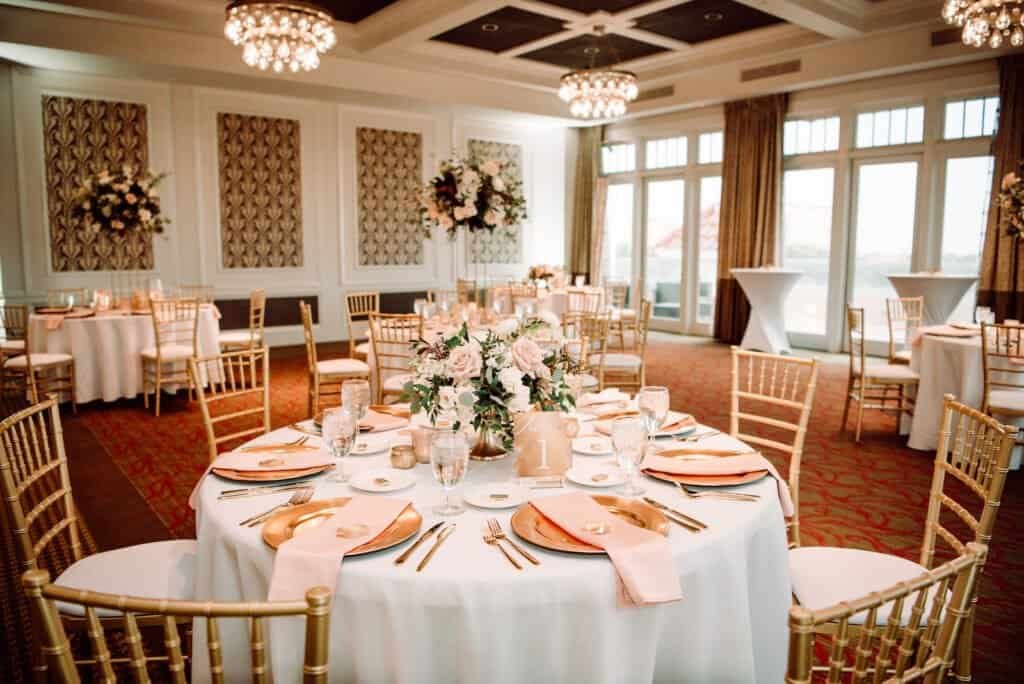
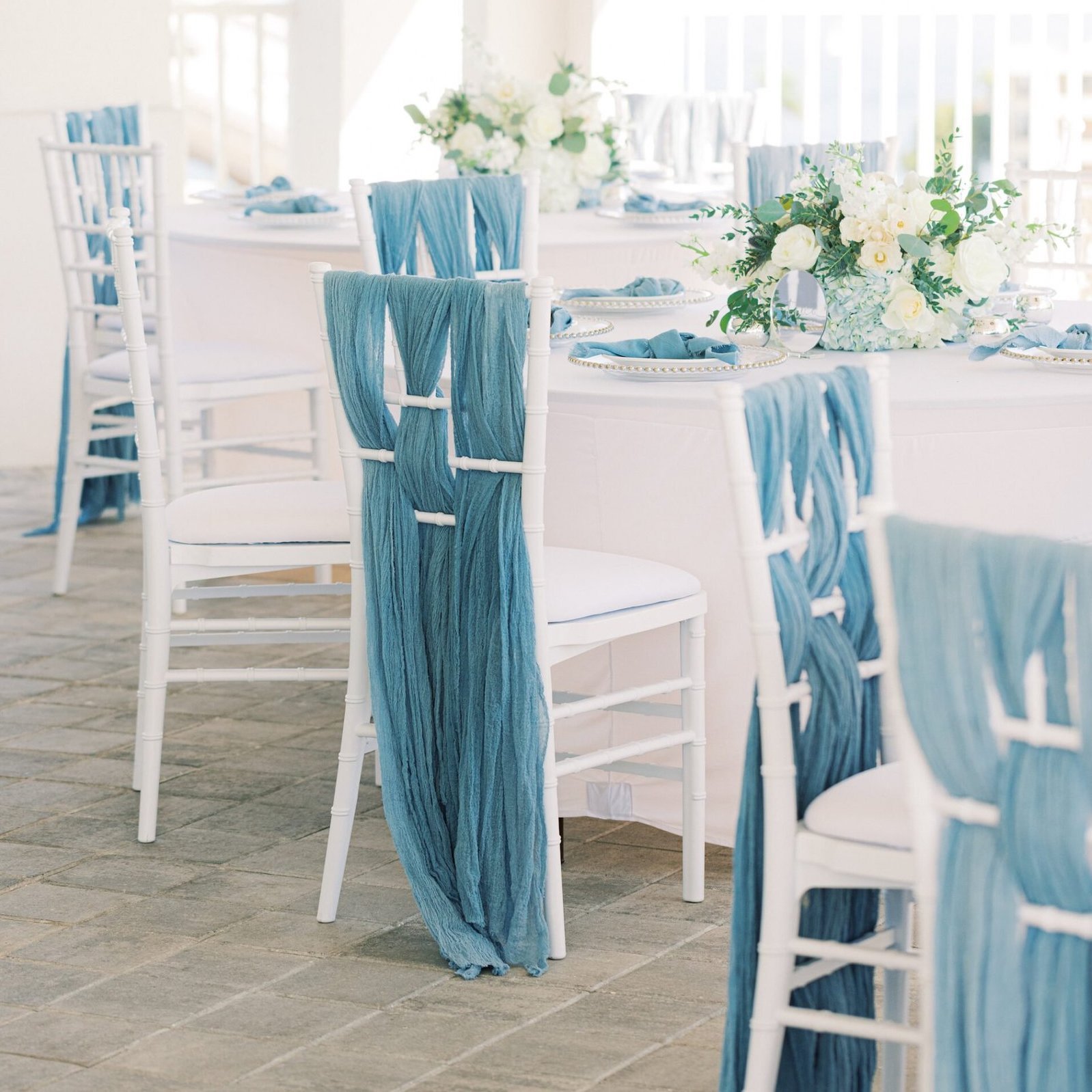
Every seat in the room was a gold Chiavari, across both the rounds and the long banquet runs. Gold is the right metal for a fall boho palette — terracotta, rust, cream and dried grasses are all warm tones, and a cool silver or a black frame in that scheme reads as a foreign object at every place setting.
The frame matters as much as the finish. A hall this size seats a lot of people, and a heavier chair with a solid back would build a visual wall at seat-back height right across the room, cancelling out the space the ceiling drape just opened up. The Chiavari’s open back keeps the room legible from any angle, which is why the wide shots here still read as one large space rather than a car park of furniture.
Mixing rounds with long runs is a floor-plan decision rather than a styling one. Rounds seat a wide guest list efficiently and let eight people talk; long tables give the room its lines and give tall centrepieces somewhere to march down. In a rectangular hall the runs are set along the axis of the room and the rounds fill the corners, which keeps service routes straight and stops the layout from fighting the shape of the building. Chairs are then spaced from the table seams outward, so the last two seats at each end are not the squeezed ones.
Shop this look
Working with a hall and a blank ceiling?
Ceiling drape, wall draping, lighting, seating and tables come from one order across Tampa Bay, rigged to what the building can actually carry.
Wedding Credits
Venue: Spanos Pappas Community Center, Tarpon Springs · Hair and Makeup: Femme Akoi Beauty Studio · Ceiling Draping, Wall Draping, Lighting, Chiavari Chairs and Tables: Gabro Event Services · Originally featured on Marry Me Tampa Bay.